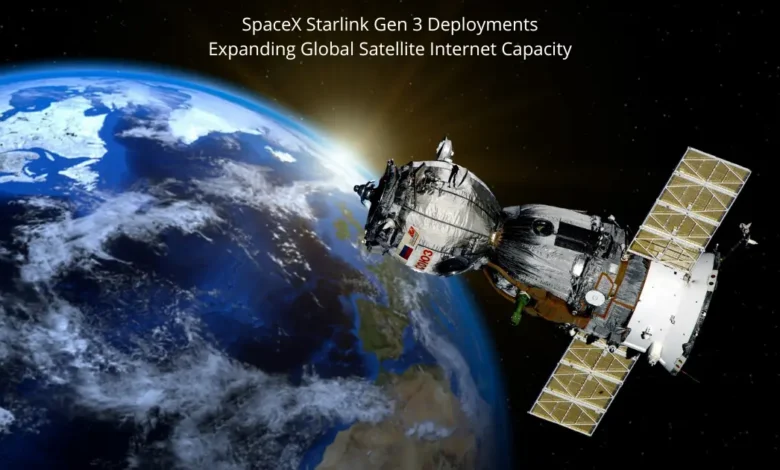
SpaceX Starlink Gen 3 Deployments Expanding Global Satellite Internet Capacity. The infrastructure supporting global satellite internet is expanding at a rapid pace. As decentralized workspaces, remote research facilities, and rural communities demand more data bandwidth, SpaceX has accelerated its launching schedule. The systematic deployment of Starlink Gen 3 deployments (utilizing advanced direct-to-cell technologies and V2 Mini hardware frameworks) has permanently altered the parameters of global telecommunications.
For network professionals and technology enthusiasts tracking global connectivity, these latest hardware upgrades represent a critical shift in how data moves across the planet.
This Tech News comprehensive report evaluates the infrastructure upgrades of the Gen 3 Starlink satellites, their deployment schedules, and how they solve regional network congestion.


Technical Upgrades: Inside the Gen 3 Space Hardware
The Gen 3 satellite frameworks are substantially larger and more capable than their predecessor platforms. By maximizing the cargo capacity of SpaceX’s Falcon 9 launch vehicles, engineers have packed advanced communication payloads into each satellite chassis.
1. Optical Laser Inter-Satellite Links (ISLs)
Traditional communication satellites required continuous line-of-sight connectivity with a ground base station to relay data packets. The Gen 3 hardware utilizes advanced optical laser cross-links. This allows satellites to beam data directly to each other through the vacuum of space at the speed of light.
As a result, Starlink can deliver high-speed connectivity over open oceans, deep deserts, and polar regions where building a local ground station is physically impossible.
2. Massive Phased-Array Antennas
The ground footprint of a single satellite beam has multiplied. The Gen 3 arrays utilize highly sensitive, scalable radio frequencies that can shape data beams dynamically. This active beamforming targets high-density usage zones, delivering concentrated bandwidth to urban fringes or active maritime shipping lanes without starving surrounding rural users.
Solving the Network Congestion Bottleneck
As millions of permanent residential users, RV digital nomads, and enterprise networks activate new subscription packages, localized network congestion has historically caused minor speed drops during peak evening hours.
The primary mission of the Gen 3 deployments is to obliterate this bandwidth bottleneck:
- Increased Spectral Efficiency: By accessing newly allocated spectrum frequencies, Gen 3 hardware minimizes signal interference, ensuring consistent download speeds even in densely populated coverage cells.
- Lower Network Latency: Enhanced onboard routing processors minimize the time it takes for a satellite to receive, process, and re-transmit a data packet, stabilizing user ping for real-time cloud operations.
Gen 2 vs. Gen 3 Starlink Satellite Hardware
| Hardware Attribute | Starlink Gen 2 (V2 Mini Infrastructure) | Starlink Gen 3 / Advanced V2 Platforms |
|---|---|---|
| Physical Space Mass | Approximately 800 kg | Over 1,250 kg per chassis |
| Data Throughput Capacity | Up to 165 Gbps per satellite | Estimated 300+ Gbps per satellite |
| Laser Cross-Link Speed | Generation 1 Optical Interconnects | Advanced High-Bandwidth Laser Links |
| Direct-to-Cell Integration | Limited testing modules | Fully integrated commercial arrays |
| Primary Structural Goal | Establish baseline LEO coverage | Scale network capacity and eliminate congestion |
Seamless Connectivity Frameworks
While SpaceX continues to update the orbital layer of the internet, users must ensure their local hardware perimeters are optimized to handle these upgraded multi-megabit data streams. If your home network utilizes legacy distribution points, internal hardware bottlenecks can artificially throttle your high-speed space link.
To guarantee that your local wireless footprint matches the advanced throughput of the Gen 3 space network, deploying high-performance local network routing infrastructure is recommended. Learn how to optimize your indoor coverage by reading our technical analysis of the best mesh Wi-Fi systems to pair with your satellite internet router.
What the Gen 3 Deployment Means for the Future
The current deployment schedule indicates that SpaceX will continue launching multiple Falcon 9 fleets every single week throughout the year. This aggressive infrastructure scaling ensures that the LEO space grid remains ahead of consumer data demands.
As these advanced satellites go live sequentially, the global digital divide will continue to shrink, providing high-performance, low-latency, and unthrottled internet infrastructure to every square kilometer of the earth.
Discover more from Tech News Radar
Subscribe to get the latest posts sent to your email.